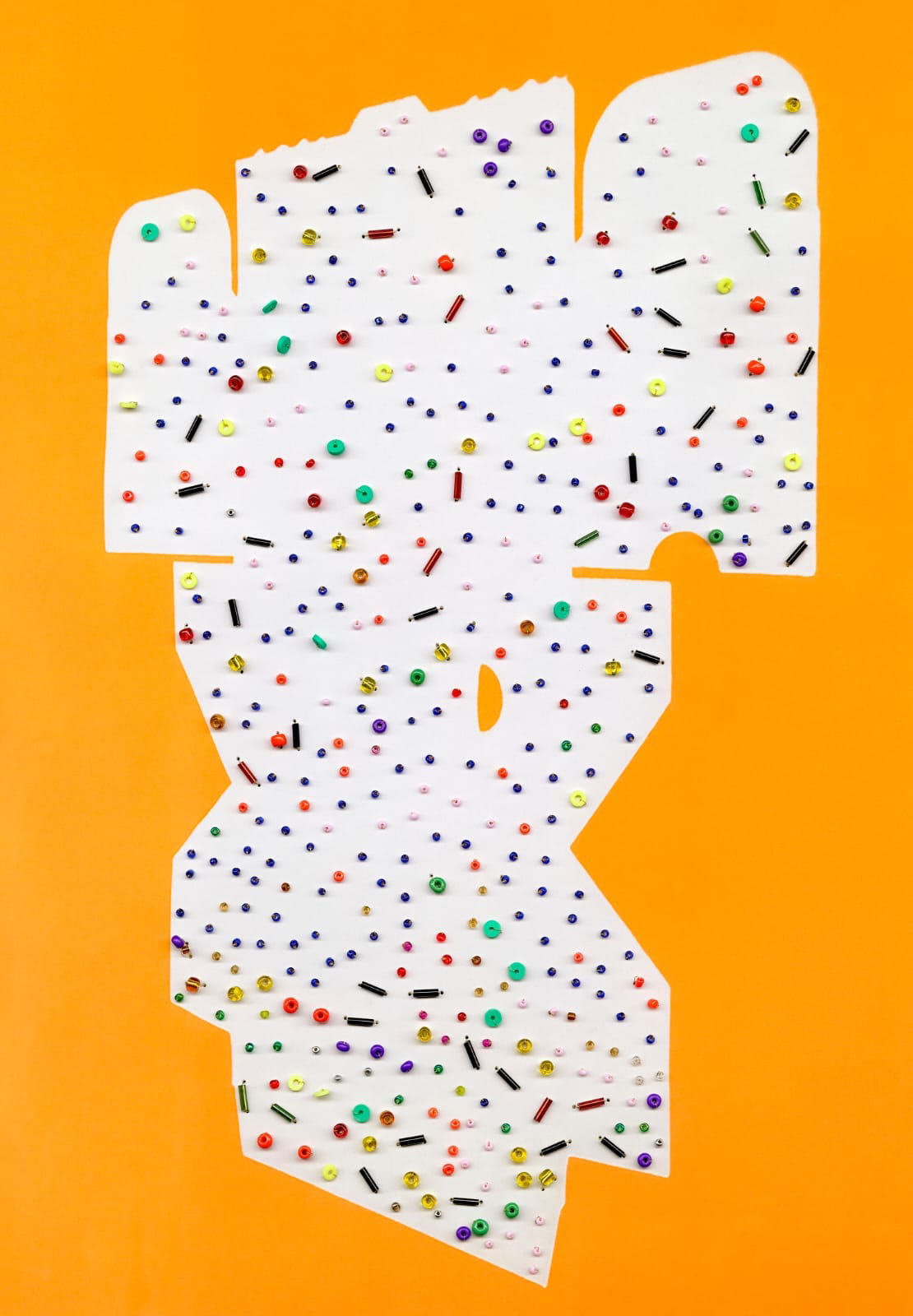
Life, A Box of Surprises: Emilia Sandoval as Hybrid Agent
All day, everywhere, all the time, we cannot help but see boxes, advertising and consumer products, all things that will eventually become rubbish and that we can only hope will be recycled. Among the works shown here, some have a detailed and interesting exterior, others frame striking elements and still others are just things that were once boxes. The artist is inviting us to consider a deeper idea. Their use value has been counteracted: these boxes can no longer contain surprises.
This is indicated by the title of the largest series included here, Abalorio, which is the Spanish word for beads and beadwork: literally objects known and categorized for their decorative use, but also for their lack of value. So should the viewer focus their gaze on the box itself, on what it contains, or outside of it … on what surrounds it?
Emphasizing the existence and qualities of the box itself would remind us that boxes are a fundamental part of the capitalist system that manipulates us. On this occasion,[1] the artist tries to formally ignore that the task of the hidden side of these flat pieces of cardboard that wants to sell us the goods they contain by hooking us with their zany logos, glowing colours, shiny fonts and witty slogans.
By preventing each box from fulfilling its desire to sell and protect their products, they themselves become products. Products of a subjective, ephemeral value, one given and applied by the art world, by external forces and factors.
In that the moment of unmaking and silencing the boxes, Sandoval eliminates their meaning. During the useful life of a box its function is to enclose and limit: to separate what is inside from what is outside. Which one wins, which one deserves our attention?
The artist is portraying all of us and herself simultaneously—while discussing the usual cultural dichotomies: centre-periphery, minority-majority, migrant-dominant.
The Hybrid Agency of a Modern Migration
Life, a Box of Surprises was first organised and shown in the city of Oaxaca in 2024 to mark and celebrate the fact that twenty years ago Emilia Sandoval completed an odyssey of 1,179 miles from her native Chihuahua, Chihuahua, to be received, respected and loved, while living and working as an artist in the Oaxacan capital. In order to bottle, analyse and redistribute the key to her success, we must look beyond the sole factors of cultural and professional survival.
Oaxacan contemporary art, as an entity, has always been a bastion from which to defend and promote inclusion and celebrate difference due, in large part, to the peculiar combination of Isthmus indigeneity and Parisian post-modernity lived by Francisco Toledo (1940–2019), the founder of said community.[2]
Arriving with a similar vision and attitude helped establish true and lasting relationships. Of course, she was also Mexican, an artist, a thinker and an innovator, bringing with her what T. S. Eliot called the “bafflingly alike and different” between an immigrant and the parent culture.[3] She was indeed a subaltern subject, but that helps, seen in post-colonial terms, in creating hybrid agency—the confrontation with differences that come from outside causes the host to reflect on its own hegemony and self-containment.[4] In other words, her strength comes from bringing something new, mixing it with the existing culture and causing everyone to realise that the resultant invention is a markedly different but improved version of the old.
Her work and the way she has forged her career are both contemporary but we must respect that which is known: wherever it is, or wherever it is from, art is a meritocracy. That said, Sandoval’s achievement does not depend solely on the quality of her cultural production, as her power is based on the disarming manner of kindness and happiness she emits while promoting sustainability and criticizing the art world with a permanent smile: qualities of an invaluable nature.
Neil Pyatt
San Andrés Cholula
June, 2024
[1] Sandoval’s ongoing Botany: New Species (2008–24) series reflects on contemporary society, scientific manipulation, the massification of everyday products, and the overproduction of clothing garments which form part of the “fast fashion” movement. New techniques include: a) acrylic paint dripped onto manta fabric or linen to create organic formations over which she embroiders fragments of plastic bags from consumer products or pieces of recycled clothing; while b) is a collage technique based on watercolor paintings combined with cuttings from design or contemporary art magazines that also feature some embroidery. The titles of these pieces consist of the plants’ common and scientific names combined with the brand name of the packaging or goods used in each work. 
[2] Neil Pyatt, ‘The Foundations of Oaxacan Contemporary Art’, in Contemporary Art and Community Altruism in Oaxaca: Hybrid Agency, by Neil Pyatt (Cambridge Scholars Publishing, 2018), 60–89. Further reading can be found in Olivier Debroise, ‘Insurgent Toledo’, in The Age of Discrepancies: Art and Visual Culture in Mexico, 1968-1997, ed. by Olivier Debroise, Cuauhtémoc Medina and Alvaro Vázquez Mantecón (Mexico City: UNAM, 2007), 250–55.
[3] T. S. Eliot, Notes towards the Definition of Culture, (New York: Harcourt Brace and Company, 1949) 62.
[4] For a complete understanding of the interstitial space and how hybrid agencies gain strength without seeking cultural supremacy or sovereignty, see Homi K. Bhabha, The Location of Culture (London: Routledge, 1994).